LED Volume Stage: What It Is, How It Works, and When to Use One
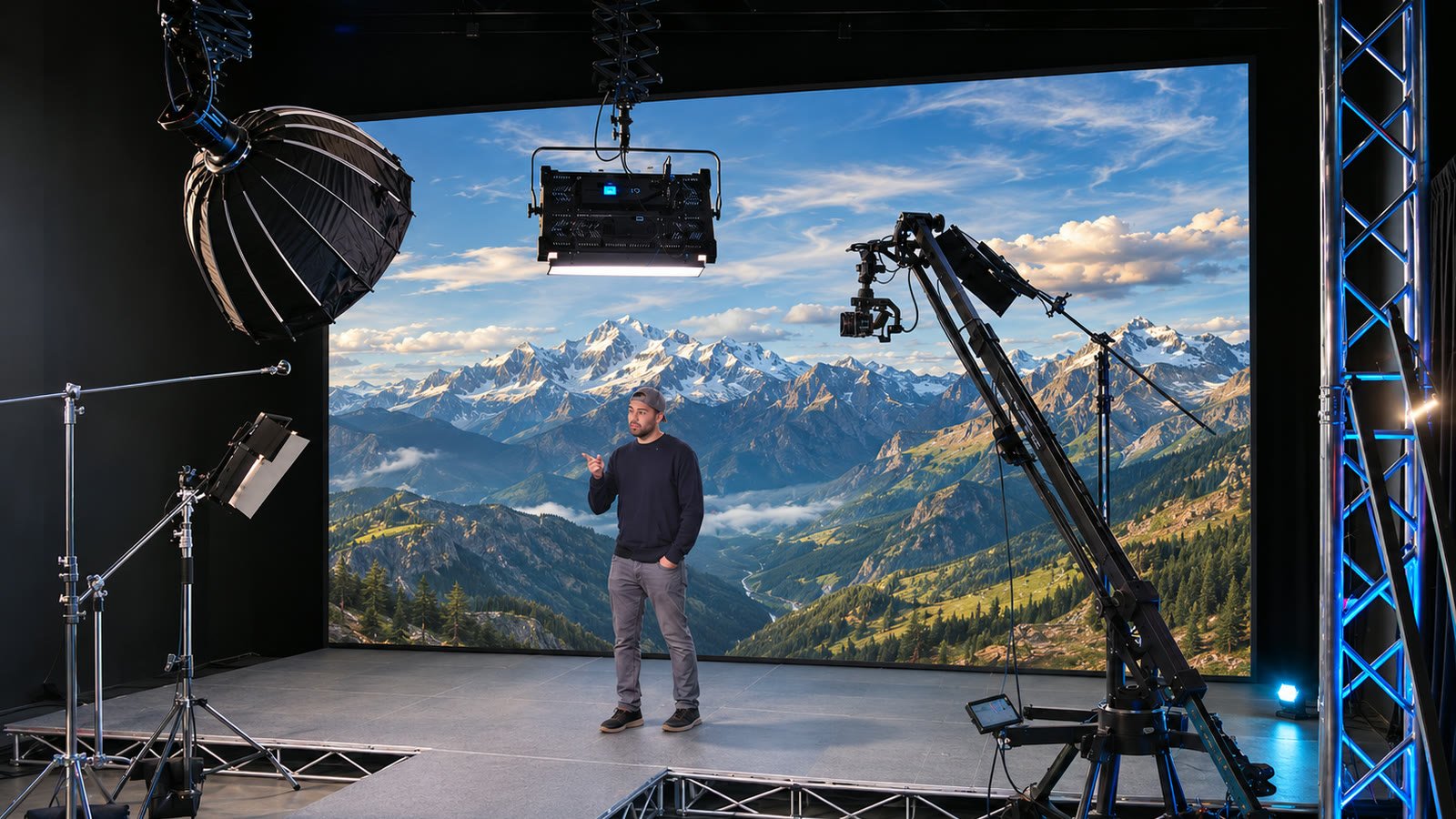
An LED volume stage swaps the green screen for a giant screen that shows the world your scene lives in. The talent stands in it, and the camera records it for real.
I get asked about LED volumes more than any other piece of gear in our building.
Most people have seen the results without knowing it. Commercials, talk shows, and big streaming series all use them now.
The good news for brands outside Los Angeles and Atlanta: you no longer need a Hollywood soundstage to shoot this way. Clients fly in to our stage in South Carolina from across the country.
Here is what an LED volume stage actually is, how virtual production works on one, how it compares with green screen, and how to tell whether your next shoot belongs on one.
The short answer: an LED volume is a wall of LED panels that displays a background behind your talent while you film. It replaces green screen for many shoots, because the background is captured in camera, it lights the people in front of it, and there is far less to fix in the edit. It is the right choice when you want a location you cannot easily travel to, a look that changes between setups, or a polished set without building one.
What is an LED volume stage?
An LED volume is a large screen built from LED panels, placed behind the action as the backdrop for a scene.
On the biggest film stages, the screens wrap around the set and even cover the ceiling. That enclosed space is where the word "volume" comes from.
Most commercial, corporate, and podcast work uses a single flat wall. It does the same job for any shot that faces it, at a fraction of the size and cost.
The technique went mainstream with The Mandalorian in 2019, which used a wraparound LED stage running real-time game engine backgrounds. Since then, the same approach has moved from Hollywood into everyday business video.
How does virtual production on an LED wall work?
Virtual production simply means the background is created digitally and filmed live, instead of being added later.
A shoot on an LED wall comes together in three layers.
- The background: a photo, a video plate, or a 3D environment, loaded onto the wall before the shoot
- The practical set: real furniture, props, and flooring in front of the wall, so the talent has something physical to stand in
- The camera and lights: framing and lighting that blend the real set into the screen, so the two read as one place
That middle layer is the secret most people miss. A real chair and a real rug in the foreground are what sell the illusion that the city skyline behind them is real too.
A well-chosen background, a slightly soft focus on the wall, and smart camera placement do the rest, so the scene reads as natural on screen.
LED wall vs green screen
Green screen still has its place. But for most of the shoots we see, an LED wall wins on the things clients care about: how real it looks and how fast it gets done.
| LED wall | Green screen | |
|---|---|---|
| What you see on set | The finished background, live on the monitor | A green wall, with the background added later |
| Light on the talent | Natural color and reflections from the scene itself | Green spill that has to be cleaned up |
| Hair, glass, and fine detail | Captured as is | Hard to key cleanly |
| Post-production | Little to no compositing | Keying and compositing on every shot |
| Performance | Talent reacts to a real environment | Talent imagines what is there |
| Changing the background later | Locked in once filmed | Fully flexible in the edit |
| Very wide or full-body shots | Limited by the size of the wall | Easier, with a large enough cyc |
The biggest difference is light. The wall glows with the colors of the scene, so a sunset background puts warm light on your speaker's face, and a product on a table picks up real reflections.
With green screen, that light has to be faked, and the edges of every shot have to be cleaned by hand.
What is pixel pitch, and why does it matter?
Pixel pitch is the distance between the centers of two LEDs on the wall, measured in millimeters.
The smaller the number, the tighter the pixels, and the closer the camera can get before the wall starts to look like a screen.
Too coarse a pitch for the distance creates moiré, a shimmering, wavy pattern that appears when the camera resolves individual LEDs. Keeping the wall slightly out of focus and some distance behind the talent prevents it.
Our wall runs at 1.9 mm, which gives us room for close interview framing and product shots without fighting moiré.
What kinds of projects work best on an LED volume?
- Commercials and brand films that need a location you cannot afford to travel to
- Executive messages and interviews that should look like a polished office, not a conference room
- Video podcasts and series that want a fresh set every season without rebuilding anything
- Product videos where reflections and real light make the product look its best
- Livestreams and virtual events that need a branded stage for remote audiences
- Music videos and indie film scenes set in places that would take a crew days to reach
Where it is not the best fit: a scene that needs people walking toward the camera from far away, or a project where you know you will want to change the background after the shoot. Those still belong on location or on green screen.
How to plan an LED volume shoot
Choose the backgrounds early. The environment is your location scout. Pick it, or have it built for your brand, before shoot day.
Match the practical set to the screen. The furniture, floor, and props should belong in the world on the wall.
Frame inside the wall. Plan your widest shot first, so every angle stays inside the screen.
Light for the scene, not the studio. If the background is a sunny afternoon, the key light on your talent should feel like that sun.
Use the time you save. Changing a location takes minutes instead of a company move. Plan extra setups and social cuts into the same day.
From the stage floor: The shots that fool people are rarely the ones with the most impressive background. They are the ones where the foreground is real. Spend as much thought on the chair, the table, and the floor as you do on the skyline.
How much does it cost to shoot on an LED volume?
A day on an LED stage usually costs more than a day on a green screen stage. The total project often costs less.
You skip travel for the crew and talent, permits, location fees, and the compositing hours green screen needs in post.
The things that move the price are how many hours you need the stage, how much crew and gear the shoot calls for, and whether you use existing backgrounds or need a custom environment built.
Our LED stage, 13 minutes from GSP
Our main stage is built around a 25' × 14' LED wall at a 1.9 mm pitch, with truss-mounted lighting, a dolly track, and a jib crane.
We film on three RED Komodo 6K and three Blackmagic 4K studio cameras, switched live from a glassed control room.
The background library is unlimited, and we can build a custom environment around your brand. A set-building shop next door handles the practical pieces in front of the wall.
We work with national brands as well as regional companies, and the stage is built to make travel easy.
Greenville-Spartanburg International Airport (GSP) is 13 minutes away, and we can pick you and your team up at the terminal. The studio even has its own helicopter and landing pad.
You can fly in for the morning, shoot on the wall, and be home that night. For companies that want this capability in-house, we also design and install studios on site.
Frequently asked questions
What is an LED volume?
An LED volume is a stage with a large LED screen, or several screens, that displays a digital background behind the talent while the camera films. The background is captured in camera instead of being added in post-production.
Is an LED wall better than green screen?
For most interviews, commercials, podcasts, and product shots, yes. It gives natural light and reflections, handles hair and glass cleanly, and needs little compositing. Green screen is still better for very wide shots or when the background must change after filming.
What is the difference between an LED volume and virtual production?
Virtual production is the method: creating backgrounds digitally and filming them live. The LED volume is the stage that makes it possible by showing those backgrounds behind the talent.
Can you use your own backgrounds on an LED wall?
Yes. You can bring photos, video plates, or 3D environments, choose from a stage's library, or have a custom background built to match your brand.
How far in advance should we book an LED stage?
Allow time to choose or build the backgrounds and plan the practical set. A shoot using library backgrounds can come together quickly; a custom environment needs more lead time.
Do you work with clients from outside South Carolina?
Yes. We serve national and regional clients. The studio is 13 minutes from Greenville-Spartanburg International Airport (GSP), we can pick your team up there, and the studio has its own helicopter and landing pad.
Shoot on our LED stage
RS Media Group films commercials and brand videos, video podcasts, and livestreams on our LED stage, with the crew and control room already in place.
Flying in, or want to see the wall before you book? Take a look inside the studio, call (864) 606-FILM (3456), or send us a note.